If you are a licensed massage therapist searching for a massage room for rent, you have probably noticed that most of the advice online was written for hairstylists. It talks about styling stations and color bars. It says very little about the things that decide whether your room works: quiet, temperature, linens, and a license most hair professionals never have to think about.
I want to be upfront. I am a cosmetologist by trade, not a massage therapist. But I have leased and run my own suite, and I spent more than 20 years in procurement, where my job was to read contracts and ask the questions nobody wanted to answer. This guide is that list of questions, rewritten for the way you work.
Why a private suite suits massage therapy
Massage is one of the few services where the room is part of the treatment. Your client is lying still, with their eyes closed, for an hour or more. They notice everything: a door slamming, a cold draft, a conversation in the hallway.
In a spa or franchise, someone else controls those things, along with your schedule, your prices and how long you get between sessions. In a private suite, you do. You decide the session length, the music, the linens, the products and how much time you leave yourself to reset the room and rest your hands. That control is the real reason therapists go independent, and it is why the room deserves a careful look before you commit.
Your options when you look for a massage room for rent
Most therapists end up comparing three arrangements. Each can work. They suit different stages of a practice.
| Arrangement | What you control | What to watch |
|---|---|---|
| A room inside someone else's spa, salon or clinic | Your own clients and, usually, your prices | Shared schedule, the host's noise and hours, and what happens to you if the host moves or closes |
| A private suite in a salon suite building | Your room, hours, prices, products and brand | Sound between suites, what the rent covers, and how the location is licensed for massage |
| Your own standalone commercial space | Everything, including signage and layout | Longer leases, build-out costs, utilities, maintenance and the full weight of being the only tenant |
For an established therapist with a steady book, a private suite often sits in the practical middle. You get a door that locks and a business that is fully yours, without taking on a build-out. If you are weighing a shared room against a private one, our comparison of salon suite vs booth rental covers the trade-offs in more detail.
9 things to check before you rent
Bring this list to every tour. A good landlord will be glad you asked.
1. Quiet
Stand in the room with the door closed for a few minutes and just listen. Then ask who your neighbors would be. A suite next to blow dryers or clippers sounds very different from one next to an esthetician or a lash artist. Visit at a busy time of day if you can, not only when the building is empty.
2. Space for your table and your body
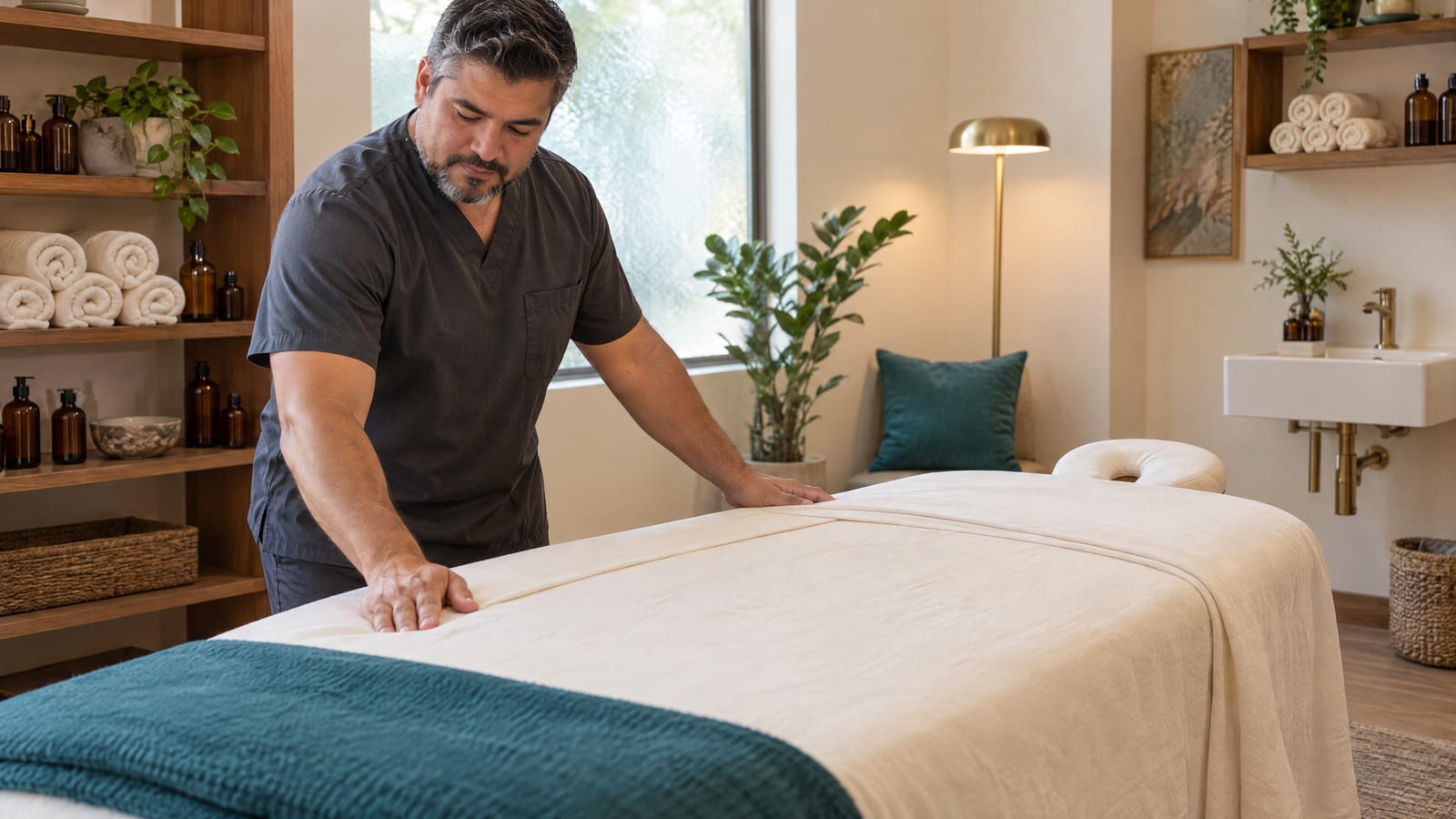
A room can look generous until your table is in it. A typical massage table is roughly six feet long, and you need room to move around every side of it without twisting or bumping a wall. Bring your table's measurements and a tape measure. Mark out the table on the floor and walk around it the way you would during a session. Then check where your stool, your storage and a chair for the client's belongings would go.
3. Temperature and lighting
Ask whether you can control the temperature in your own suite or whether it is set for the whole building. A client under a sheet feels cold long before you do. Look at the lighting too. Can overhead lights be dimmed or switched off in favor of lamps? Is there a window, and can it be covered?
4. Water and hygiene
You need to wash your hands between every client, so a sink inside the suite matters more than it might seem. Without one, you are walking down a hallway with oil on your hands several times a day. At Elegance Salon Suites, every suite includes a private sink for this reason.
5. Linens and laundry
Massage uses more linen than almost any other service: sheets, face cradle covers, towels and blankets for every client. Ask whether there is laundry on site and how it works, or plan for a linen service or laundering at home. Then look for a place in the room to store clean sets and a closed place for used ones.
6. Access and hours
Many massage clients book early mornings, evenings and weekends. Ask what hours you can use the building. With 24-hour keyless entry, your schedule is your own. Walk the path a client would take from the parking lot to your door. Think about someone arriving in pain or leaving very relaxed: is the route short, well lit and easy to follow? Is there a comfortable place to wait?
7. What the rent covers
Ask for a plain list of what is included and what is billed separately. Utilities, Wi-Fi, maintenance and laundry are the usual questions. Predictable costs make it far easier to work out how many sessions cover your week. Our salon suite business plan guide shows how to find that break-even number in a few steps.
8. Lease terms
Read the whole lease before you sign, slowly. Look for the length of the term, how and when rent is paid, the notice you must give to leave, whether you can paint or add equipment, and any rules about products, hours or signage. If a clause is unclear, ask for it in writing. If something still worries you, have an attorney look at it.
9. Licensing for the location
This is the one that catches people out, so it gets its own section.
Florida's massage establishment license
In Florida, massage therapy is regulated by the Department of Health through the Florida Board of Massage Therapy. That is a different agency from the one that licenses cosmetologists and barbers, which means a building full of licensed salons is not automatically set up for massage.
Your personal massage therapist license is one piece. The place where you practice is another. Under section 480.043 of the Florida Statutes, a massage establishment may not operate without its own license. In general terms, the statute and the Board's application also call for:
- A passing inspection of the space before the establishment license is issued
- Proof of liability insurance for the establishment
- A designated establishment manager who holds a qualifying license and practices there
- Background screening for the establishment owner
- A required human trafficking awareness sign posted in the establishment
The statute also says an establishment license cannot be transferred to another person, and that moving it to a new location requires an approved inspection first. So if you already hold an establishment license somewhere else, do not assume it follows you to a new room.
What this means in practice: before you sign any lease, ask the landlord how massage therapists in the building are licensed, and confirm with the Board what applies to you in that specific space. I am not giving legal advice here, and rules and fees change. Go to the source at floridasmassagetherapy.gov, and leave yourself time for the application and inspection before your planned first day.
Setting up the room once it is yours
You do not need much to open, but what you bring should be chosen with care.
- Your table and stool. Buy for your own body mechanics first. You will be using them all day.
- Linens. Enough full sets for your busiest day, plus spares.
- Storage. Closed cabinets or shelving for linens, oils and lotions so the room stays calm to look at.
- Sound. A small speaker and, if you like, a white noise machine near the door.
- Light. One or two warm lamps so you are not relying on overhead lights.
- A client corner. A chair, hooks and a small tray for jewelry and glasses.
Ask what you are allowed to change. At Elegance, tenants may paint, add equipment and personalize their suite, and suites can be leased unfurnished, which suits a therapist who needs open floor for a table instead of a styling station. For more ideas, see our post on setting up your suite for client comfort.
Frequently asked questions
Can a massage therapist rent a salon suite?
Yes. Many salon suite buildings lease to massage therapists and other wellness professionals alongside hair and skin care professionals. The questions to settle first are whether the room suits massage (quiet, space, a sink) and how the location is licensed for massage in your state.
Do I need a massage establishment license to rent a room in Florida?
Florida law requires a massage establishment to be licensed before it operates, and that is separate from your therapist license. How it applies to a room you rent depends on the situation, so confirm with the Florida Board of Massage Therapy and ask the landlord before you sign.
How big should a massage room be?
There is no single right size. It depends on your table, your modalities and how much storage you need. The reliable test is to mark out your table on the floor during the tour and check that you can move around all sides comfortably.
What should I ask on a tour?
Ask who the neighboring tenants are, whether you control the temperature, what the rent includes, what hours you can access the building, what you may change in the suite, and how massage therapists there handle establishment licensing.
Is a furnished or unfurnished suite better for massage?
Furnished suites are usually set up for hair services, so many therapists prefer an unfurnished room they can arrange around the table. Ask what the options are and choose the one that leaves your floor space open.
Elegance Salon Suites is now pre-leasing private suites in Largo, FL, for massage therapists and wellness professionals from Largo, Clearwater, Seminole and across Pinellas County. Bring your table measurements and your questions. Book a private tour or call 1-813-776-2787. Tours are complimentary and there's no obligation.